Voice: a sound with broad meaning containing a wealth of information in it
A voice says far more than its words. For a forensic audio examiner, that detail is the evidence, and also the challenge.
What does a voice tell us?
A voice is more than just a sequence of sounds coming out from your mouth. Voice can represent the way you want to express yourself amongst many other things. Voice can also be used as a tool to complement a musical composition or to express verbally a complex argument that produces a meaningful result for the targeted audience.
Voices are inherently complex and the amount of information we can gather through a quick analysis enables us to accurately, most times, pinpoint critical information such as the speaker’s sex (in a non-visual situation) or their emotional state.
Why does a voice matter in a forensic case?
This kind of information can signal a clear potential of forensic importance. Voice, due to its complexity and the relationship with its owner, provides a forensic audio examiner with a wealth of information which in turn allows the examiner to create a profile that will be used in a voice comparison case.
Comparing voices is challenging and it is imperative for the forensic sound examiner to know what kind of relations and interactions the different components of voice are providing in order to create a successful model for a meaningful comparison.
Voices are quite difficult to discriminate forensically, especially when problematic conditions are present during sample comparison of audio recordings. Foreground or background noises as well as other sound artefacts can interfere with the quality of the obtained voice sample.
Perhaps the most common task in forensic speaker identification requires the examination of one or more samples of an unknown voice to be compared with one or more voice samples of a known voice.
Why are voices challenging to discriminate forensically?
As I mentioned earlier the condition of the recordings during voice sample comparison can be problematic due to inferior sound quality. There are of course many other aspects which will influence the outcome of a voice sample comparison such as disguise, false information that changes or obscures the vocal formants of the speech characteristics, distortion, variations between samples which will require obtaining additional voice samples and any other differences that will affect spectra and aural characteristics during the examination.
Unknown voice samples must be compared with one or more samples of a known voice. For simplicity let’s call the unknown voice the “offender” and the known voice the “suspect”. In a legal case at the court of law the prosecution and defence need to know if the two voice samples have come from the same person. Positive identification will result in “suspect” = the “offender” and elimination will result in “suspect” = not the “offender”.
As you can understand, obtaining the highest degree of accuracy during the examination and comparison of the voice samples is imperative in order to conclude on the case of recording evidence.
What does cleaning up a noisy voice sample look like?
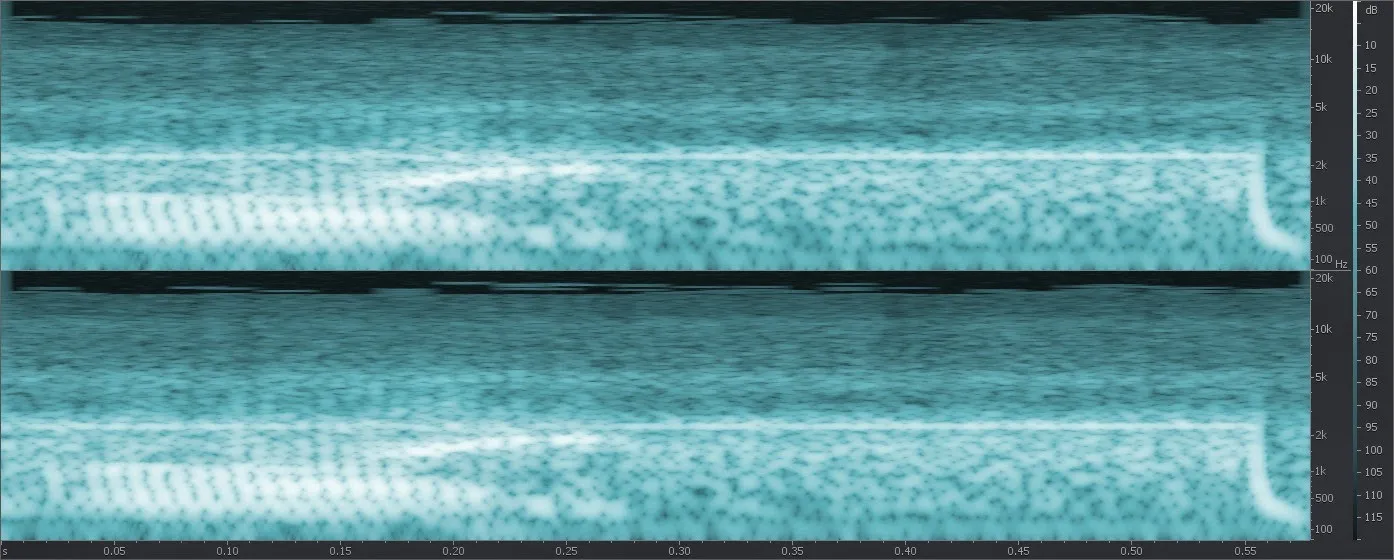
The image below displays an American male pronouncing the word “light”. However along with the word “light” there is also substantial background noise as well as a hum (the straight horizontal white line in the middle of the screen).
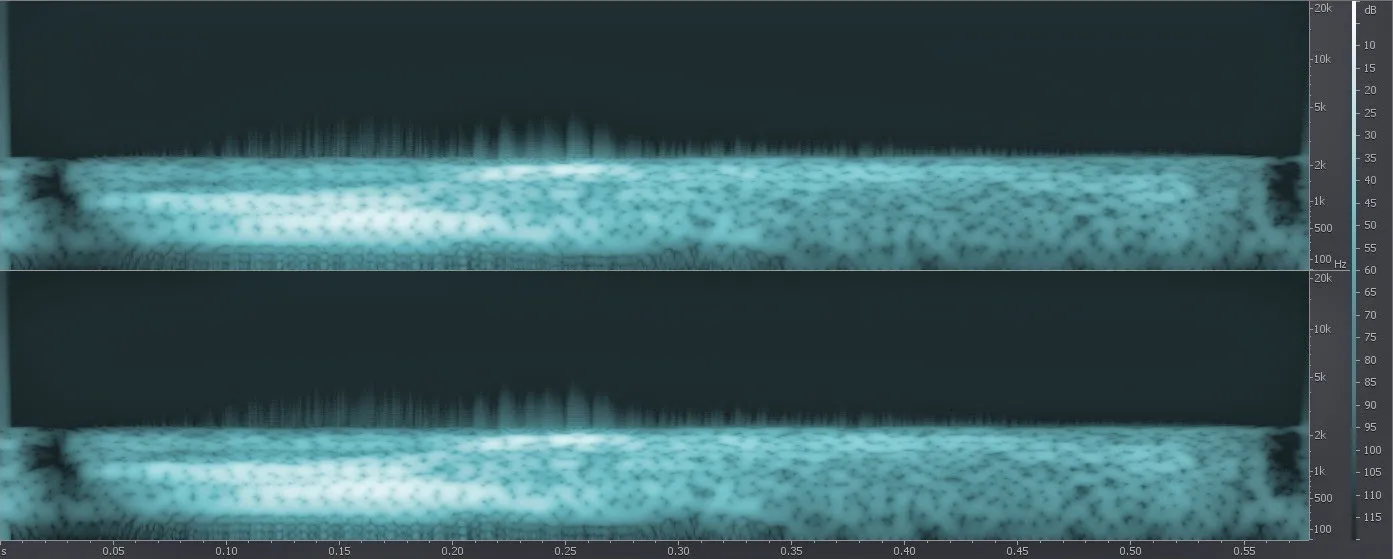
The screenshot below displays the same word “light” but with the background noise minimised and the hum eliminated.